COM·PANE

PROBLEM

Exodus's nine-month Carovana rebuilds young people in recovery. When it ends, the routine, the group and the purpose disappear on the same day.

INSIGHT

Companies already valued a day with Exodus, but only as donors. Nobody had sold them what Exodus knows how to do.

WHAT I DID

I pushed the team to narrow the scope to baking, found and managed our key source, named the concept and built the deck's narrative and visual system.

OUTCOME

Pitched to the Foundation with one deliberately small ask: a single afternoon, sold to one company, before Christmas.

THIRD SECTOR · SERVICE ECOSYSTEM

COM·PANE

Turning a nine-month journey into a daily practice a company pays for

Client

Fondazione Exodus by Don Antonio Mazzi

Role

Strategy, narrative and visual direction

Year

2026

Team

2 Designers 1 Business degree:
Maria Jose Soto
Aditya Balaji

Format

Strategic workshop — 2 weeks, POLI.design

← HOME

The Carovana doesn't fail. It ends.

01

THE VOLLEYBALL COURT IN SICILY

For forty years, Exodus has taken young people recovering from addiction on a journey the length of Italy. Don Antonio Mazzi, the priest who started it in 1985, told the first group they would set off with a healthy backside and a broken head and come back the other way round.

Andrea, a videomaker who has filmed the Carovana for years, became our main source. Ask him how the method works and you get something very concrete. Comfort is removed — no hotels, no abundance, phones limited to fifteen minutes a day for calling parents. Participants resist, then forget. After a week without one, a Coca-Cola becomes an event.

And there is always a task. On one Carovana it was an abandoned volleyball court in Sicily, which the group cleaned before they could use it.

A tangible challenge with a visible result — unlike internal personal work, which has neither.

You cannot ask somebody to repair themselves directly. You give them a court, and the repair happens inside the cleaning of it.

01

THE VOLLEYBALL COURT IN SICILY

For forty years, Exodus has taken young people recovering from addiction on a journey the length of Italy. Don Antonio Mazzi, the priest who started it in 1985, told the first group they would set off with a healthy backside and a broken head and come back the other way round.

Andrea, a videomaker who has filmed the Carovana for years, became our main source. Ask him how the method works and you get something very concrete. Comfort is removed — no hotels, no abundance, phones limited to fifteen minutes a day for calling parents. Participants resist, then forget. After a week without one, a Coca-Cola becomes an event.

And there is always a task. On one Carovana it was an abandoned volleyball court in Sicily, which the group cleaned before they could use it.

A tangible challenge with a visible result — unlike internal personal work, which has neither.

You cannot ask somebody to repair themselves directly. You give them a court, and the repair happens inside the cleaning of it.

The Carovana runs on three mechanisms: a shared routine, total interdependence and a goal you can see.
02

IL VUOTO

The journey builds three things at once: a shared routine, total interdependence, and somewhere to reach.

Then it ends, and all three disappear on the same day. The person returns to a world with no common purpose, no one depending on them, and nowhere in particular to go. Independence is the goal and it is also a cliff.

On the road, no one saves themselves alone. After it, most people do.

There is an instrument for this. Borsa Lavoro pays a graduate around €500 a month and then stops — and by every account we heard, it isn't enough.

We gave the gap a name: il vuoto. The void.

Don Mazzi died in July 2026, two months before our brief. For forty years he had been the Foundation's face and, in practice, its method.

02

IL VUOTO

The journey builds three things at once: a shared routine, total interdependence, and somewhere to reach.

Then it ends, and all three disappear on the same day. The person returns to a world with no common purpose, no one depending on them, and nowhere in particular to go. Independence is the goal and it is also a cliff.

On the road, no one saves themselves alone. After it, most people do.

There is an instrument for this. Borsa Lavoro pays a graduate around €500 a month and then stops — and by every account we heard, it isn't enough.

We gave the gap a name: il vuoto. The void.

Don Mazzi died in July 2026, two months before our brief. For forty years he had been the Foundation's face and, in practice, its method.

Il vuoto: when the journey ends, the routine, the group and the goal end with it.
03

DONORS, NOT CLIENTS

Forty years of corporate history amounts to one-day volunteering and sponsorship — Intesa Sanpaolo, KPMG, IKEA, Unilever, UPS, Zara. The client's own brief says none of it is structural. The model is van branding, not an exchange of services.

One quote carries the whole argument. KPMG's Head of Training, on the record in 2017:

"What we learn on days like this is hardly something you learn in five months of training."

A head of corporate training said in print that one day with Exodus beat five months of his own programme. Nobody ever sold him the second day.

And Exodus knows why. When we asked what a company could actually do, the answer was a short list: drive a van, help at the Christmas market, work the solidarity shop.

Every relationship begins with what Exodus needs. None begin with what Exodus knows how to do.

03

DONORS, NOT CLIENTS

Forty years of corporate history amounts to one-day volunteering and sponsorship — Intesa Sanpaolo, KPMG, IKEA, Unilever, UPS, Zara. The client's own brief says none of it is structural. The model is van branding, not an exchange of services.

One quote carries the whole argument. KPMG's Head of Training, on the record in 2017:

"What we learn on days like this is hardly something you learn in five months of training."

A head of corporate training said in print that one day with Exodus beat five months of his own programme. Nobody ever sold him the second day.

And Exodus knows why. When we asked what a company could actually do, the answer was a short list: drive a van, help at the Christmas market, work the solidarity shop.

Every relationship begins with what Exodus needs. None begin with what Exodus knows how to do.

From donors to clients: what companies get from Exodus today, and what they could buy.
04

THE DOOR WE CLOSED

Italian law requires large companies to fill a quota of disabled employees, or pay a fine for every place they leave empty. There is a legal shortcut: instead of hiring, a company can commission work from a social cooperative and count it against the quota.

Exodus owns social cooperatives. So the pitch writes itself — buy bread from us, and it settles an obligation you already have.

That is a completely different conversation from asking for a donation. It's a budget line, not goodwill.

Then we read the statute. The shortcut covers people registered as disabled. Exodus works with persone svantaggiate — a different category, on a different list.

A company signing it would still be in breach, at up to €153.20 per empty place per day.

The most saleable version of this model was the one that would have fined the company for buying it.

04

THE DOOR WE CLOSED

Italian law requires large companies to fill a quota of disabled employees, or pay a fine for every place they leave empty. There is a legal shortcut: instead of hiring, a company can commission work from a social cooperative and count it against the quota.

Exodus owns social cooperatives. So the pitch writes itself — buy bread from us, and it settles an obligation you already have.

That is a completely different conversation from asking for a donation. It's a budget line, not goodwill.

Then we read the statute. The shortcut covers people registered as disabled. Exodus works with persone svantaggiate — a different category, on a different list.

A company signing it would still be in breach, at up to €153.20 per empty place per day.

The most saleable version of this model was the one that would have fined the company for buying it.

05

"FOR NOW"

Exodus owns a historic water mill. It has a pizza oven. Guests already gather to bake together, and the community and the method are already alive on the site.

It is a closed loop. The public can't take part, and a company can't easily fund a private internal event.

So I asked Andrea something that sounded small: are the pizza-making events ever open to the public?

The answer was no. Then: "for now."

Those two words were the whole opening. The activity exists. The infrastructure exists. The ritual exists. What has never been designed is the interface between them and everyone outside.

05

"FOR NOW"

Exodus owns a historic water mill. It has a pizza oven. Guests already gather to bake together, and the community and the method are already alive on the site.

It is a closed loop. The public can't take part, and a company can't easily fund a private internal event.

So I asked Andrea something that sounded small: are the pizza-making events ever open to the public?

The answer was no. Then: "for now."

Those two words were the whole opening. The activity exists. The infrastructure exists. The ritual exists. What has never been designed is the interface between them and everyone outside.

The historic water mill, where guests already bake together.
One question to Andrea, and the two words that opened the project: "for now".
06

BREAD AS A METHOD

Bread is a court you can clean every morning.

After three changes of direction, I pushed the team to commit to one and proposed baking as that direction — then argued for it. Maria Jose turned it into a method:

Dough has a rhythm and cannot be hurried, which teaches patience. It is repetition learned through the hands — process. And it is made to be handed to somebody else — generosity. Those are the Carovana's own mechanisms, running daily instead of once a year.

The role structure is theirs too. On the road, a guest enters as a fratello minore and leaves as a fratello maggiore, protecting and guiding the next intake — one participant who arrived chaotic became the group's cook and its anchor.

COM·PANE runs that on a twelve-hour cycle. In the morning the guest makes the dough. In the afternoon the guest teaches neighbourhood children to make it.

The name holds the same idea. Companion comes from the Latin cum panis — the person you share bread with. Every loaf carries a stamp, Il Timbro: I made this, and it was worth giving away.

06

BREAD AS A METHOD

Bread is a court you can clean every morning.

After three changes of direction, I pushed the team to commit to one and proposed baking as that direction — then argued for it. Maria Jose turned it into a method:

Dough has a rhythm and cannot be hurried, which teaches patience. It is repetition learned through the hands — process. And it is made to be handed to somebody else — generosity. Those are the Carovana's own mechanisms, running daily instead of once a year.

The role structure is theirs too. On the road, a guest enters as a fratello minore and leaves as a fratello maggiore, protecting and guiding the next intake — one participant who arrived chaotic became the group's cook and its anchor.

COM·PANE runs that on a twelve-hour cycle. In the morning the guest makes the dough. In the afternoon the guest teaches neighbourhood children to make it.

The name holds the same idea. Companion comes from the Latin cum panis — the person you share bread with. Every loaf carries a stamp, Il Timbro: I made this, and it was worth giving away.

Il Pane come metodo: patience, process, generosity. Method by Maria Jose Soto.
07

WHO PAYS FOR THE AFTERNOON

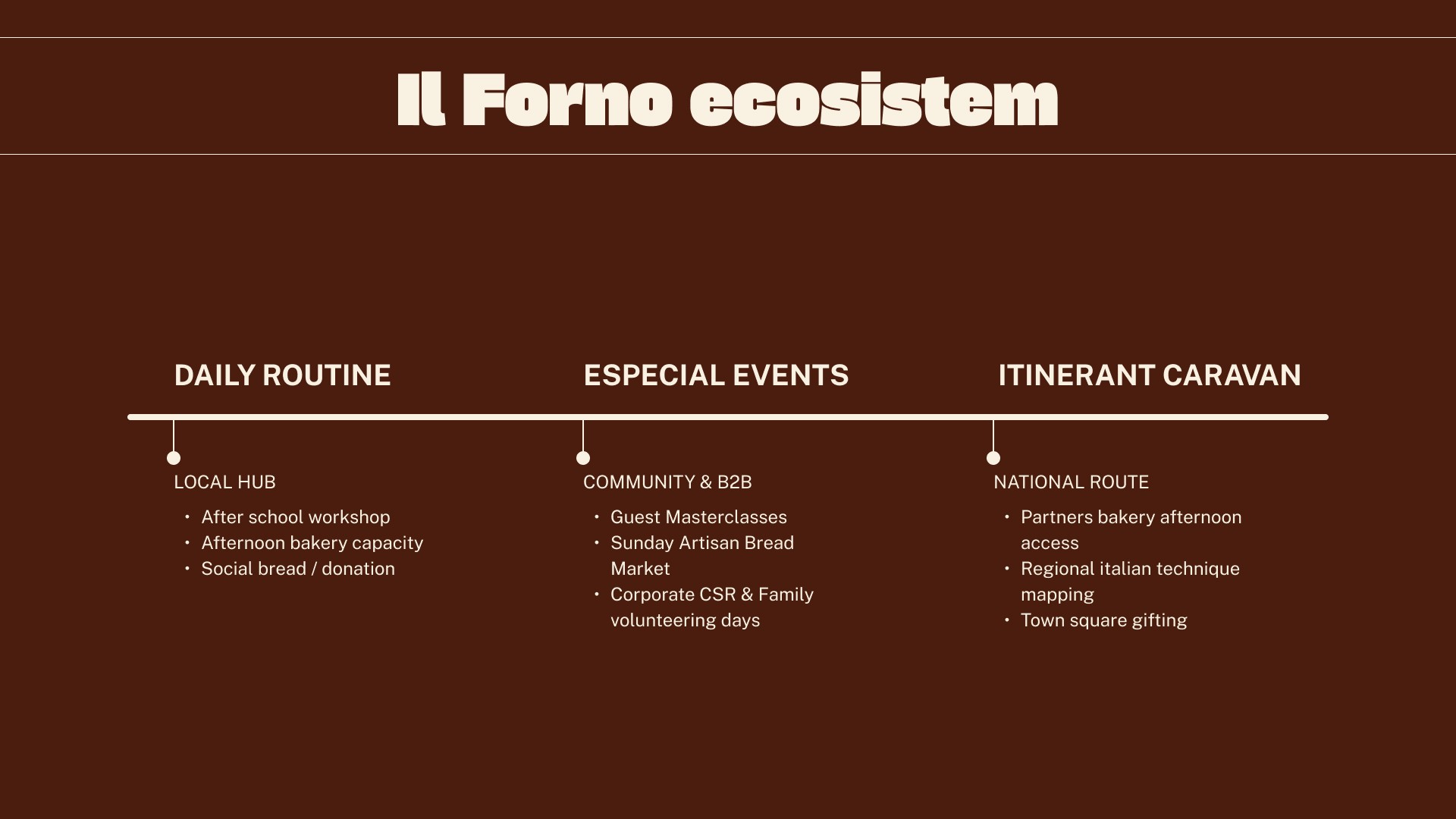
The system runs at three scales that feed each other:

  • Daily — the local hub. Dough in the morning, after-school workshop in the afternoon, bread home with the children and to local shelters.
  • Weekly — the public comes in. Guest masterclasses, a Sunday bread market, corporate and family days.
  • Annually — the Carovana takes bread on the road, learning regional techniques from partner bakeries.

One rule applied to every line of the revenue model:

In every exchange, the guest is producing or teaching. Never being observed.

A company books an afternoon and its team is taught by a guest — not by staff, not by a supervising volunteer. The company gets a day its team will actually talk about. Exodus gets a fee, and a room full of people who now know what the place is.

The same afternoon that closes il vuoto is the one the company is paying for.

We closed the pitch with the smallest possible ask: not an ecosystem, but one afternoon, sold to one company, before Christmas.

07

WHO PAYS FOR THE AFTERNOON

The system runs at three scales that feed each other:

  • Daily — the local hub. Dough in the morning, after-school workshop in the afternoon, bread home with the children and to local shelters.
  • Weekly — the public comes in. Guest masterclasses, a Sunday bread market, corporate and family days.
  • Annually — the Carovana takes bread on the road, learning regional techniques from partner bakeries.

One rule applied to every line of the revenue model:

In every exchange, the guest is producing or teaching. Never being observed.

A company books an afternoon and its team is taught by a guest — not by staff, not by a supervising volunteer. The company gets a day its team will actually talk about. Exodus gets a fee, and a room full of people who now know what the place is.

The same afternoon that closes il vuoto is the one the company is paying for.

We closed the pitch with the smallest possible ask: not an ecosystem, but one afternoon, sold to one company, before Christmas.

Il Forno ecosystem: daily routine, special events, the travelling Carovana.
Daily routine: dough in the morning, teaching children in the afternoon.
08

MY ROLE

  • The commitment. Proposing that we stop exploring and choose one direction — and proposing bread as that direction.
  • The source. Finding Andrea and managing that relationship. The volleyball court, the brothers, and "for now" all came through him.
  • The inventory. Mapping what Exodus already owned — the mill, the oven, the events — and reducing the Carovana to three operational mechanisms.
  • The name. COM·PANE, from cum panis.
  • The argument. The deck's narrative: the shift from donors to clients, what a company can buy, the chart that returns at the end, and the closing ask.
  • The look. The deck's visual system — palette, type, a style sheet for the team — and every event poster, designed so the project would never read as charity.
08

MY ROLE

  • The commitment. Proposing that we stop exploring and choose one direction — and proposing bread as that direction.
  • The source. Finding Andrea and managing that relationship. The volleyball court, the brothers, and "for now" all came through him.
  • The inventory. Mapping what Exodus already owned — the mill, the oven, the events — and reducing the Carovana to three operational mechanisms.
  • The name. COM·PANE, from cum panis.
  • The argument. The deck's narrative: the shift from donors to clients, what a company can buy, the chart that returns at the end, and the closing ask.
  • The look. The deck's visual system — palette, type, a style sheet for the team — and every event poster, designed so the project would never read as charity.
Open day at the mill, for the public. Poster design: Julio Corrales
Building the oven together, for volunteers.
A baking afternoon for company teams.
09

WHAT I'D DO DIFFERENTLY

  • We pivoted three times in ten days, and the final concept had about forty-eight hours. Each change answered a good piece of feedback. None of them was a direction we had chosen and were prepared to defend. I argued for committing — I should have argued for it on day three, not day eight.
  • No commercial figure was ever obtained. What a company pays per head for comparable formation, whether Exodus's insurance covers external participants at the oven, what the build costs. The model names the right moment to charge and still cannot say how much.
  • We never spoke to a guest. We designed a role for young people — morning baker, afternoon instructor — with none of them in the room, for a foundation whose entire ethos is the people it serves. It would have cost one afternoon.

Next Project

Experiencia Morada →

Have a problem worth solving?

Open to strategic design internships in Milan, Spain or remote.

LINKEDIN ↗
or open your mail app →
MILAN, ITALYJULIO CORRALES · 2026